
A just transition to a low-carbon economy must be inclusive and fair, addressing the needs of workers, communities, and industries affected by transformation. The International Labour Organization (ILO) defines just transition as “greening the economy in a way that is as fair and inclusive as possible to everyone concerned, creating decent work opportunities and leaving no one behind.” Yet micro, small, and medium enterprises (MSMEs), which employ the majority of workers across South and Southeast Asia, remain on the periphery of just transition programs, despite being simultaneously exposed to the impacts of digital transformation and climate change.
MSMEs in the region are extraordinarily heterogeneous. In India, 98.4% of all MSMEs are micro-enterprises, and between 80% and 90% operate informally, typically home-based with limited capital. In Southeast Asia, MSMEs are more integrated into regional and global value chains through ASEAN frameworks, yet informality, weak access to finance, and concentration in vulnerable sectors which are most exposed to automation and climate disruption are common challenges.
The 2025 Asia Pacific SDG Partnership Report calls for policy coherence and a whole-of-government approach to achieve a just transition through gender equality, decent work, and enhanced social protection. Given the socio-economic role of MSMEs, a just transition also requires collaboration from the private sector and civil society. This necessitates a systems-level, outcomes-oriented approach for MSME development programs and policy—one that links enterprise performance to decent work and connects digital skills to green skills.
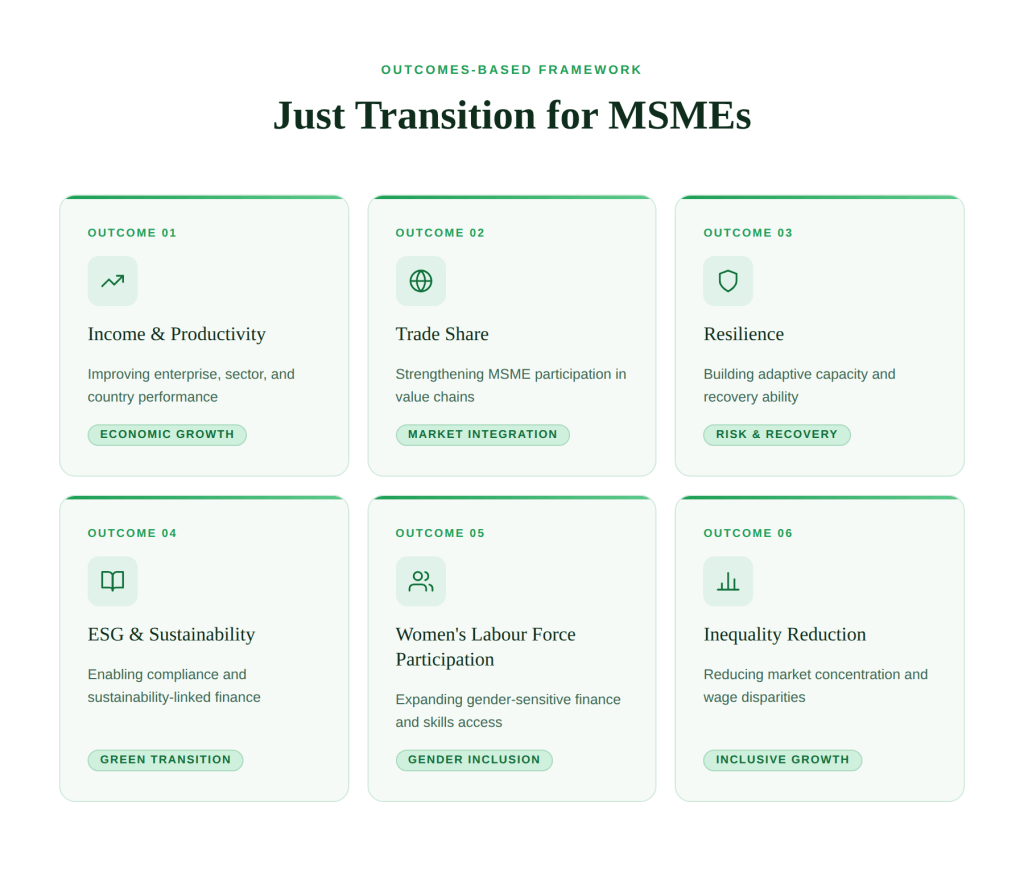
Drawing on the OECD’s MSME evaluation framework, the ILO’s Decent Work and Systems Change Initiative, and the ASEAN Coordinating Committee on Micro, Small and Medium Enterprises (ACCMSME) policy guidelines, an outcomes-based approach focusing on six measurable results can serve as a useful design and evaluation framework: income and productivity, trade share, resilience, ESG and sustainability, women’s labour force participation, and inequality reduction. This article examines each in turn.
1. Income and Productivity Gains
Small businesses struggle with productivity compared to large companies, making productivity growth a central aim of government policy. According to the McKinsey Global Institute (2024), narrowing the productivity gap in emerging economies could unlock value equivalent to 10% of GDP. Yet productivity varies enormously by country, sector, firm size, and integration into value chains.
The ILO’s Decent Work program prioritizes subsectors using market systems analyses and rapid assessments, particularly in non-agricultural sectors such as tourism, construction, manufacturing, and agro-processing with a lesser evidence base and greater complexity of decent work challenges. Skilling and livelihood programs are one example of targeted investments to improve productivity and income potential. Nepal’s Employment Fund links results-based training to verified employment outcomes, improving labour market access for disadvantaged youth and women. However, individual skill gains are insufficient without business and sectoral improvements.
A systems approach addresses multiple levels simultaneously, measuring enterprise, sector, and country performance for income and productivity improvement. Policymakers can improve technology access through targeted grants and digital infrastructure, open new export markets via simplified trade frameworks, and strengthen financial systems using alternative credit data for underserved businesses. Large companies can raise MSME capabilities within their supply chains through knowledge transfer and supplier financing. MSME associations, cooperatives, and local clusters can promote inter-firm collaboration, sharing resources and expertise.
2. Trade Share Increase
Most MSMEs in South Asia operate in fragmented domestic markets with weak cross-border linkages, while their Southeast Asian counterparts are more integrated into regional and global value chains. Country context matters for trade and value chain integration, as noted by the Asian Development Policy Report 2026. For peripheral economies, MSMEs struggle with high trade costs and weak logistics, requiring basic connectivity and trade facilitation to enter global value chains (GVCs). In integrated but constrained economies, MSMEs remain locked in low-value assembly, needing capability-building, supplier development, and services reforms to upgrade. For upgraded economies, MSMEs face rising standards and digital demands, requiring innovation support, regulatory interoperability, and shared compliance systems to sustain high-value participation.
The ILO and ITC’s Trade for Jobs initiative in Uganda (co-funded by Sida) uses a market systems approach focused on dairy and tourism sectors to strengthen regional trade linkages for micro-enterprises while simultaneously building backward linkages to smallholder producers.
Supply chain linkages are equally important. First-tier suppliers are typically larger and formalized, while the overwhelming share of MSME workers sit in lower-tier, informal spaces with minimal compliance oversight and poor working conditions. Policies that strengthen forward and backward linkages such as procurement preferences, supplier development programmes, and regional trade facilitation can directly improve the position of lower-tier MSMEs in value chains. India’s public procurement guidelines, which mandate that 25% of government procurement must be from MSMEs (with 3% reserved for women-owned MSMEs), offer a practical example of demand-side inclusion, albeit at a country level.
3. Resilience Improvement
Operating environment instability whether from climate events, supply chain disruptions, or economic shocks is highly disruptive for MSMEs, especially smaller enterprises. For micro-enterprises, resilience is not merely a business problem but a question of household survival in extreme crises. The COVID-19 pandemic exposed this vulnerability: 70–80% of MSMEs in the Philippines, Malaysia, and Thailand suspended operations or ran out of funds within months.
Enterprise resilience encompasses three properties: vulnerability, adaptive capacity, and recovery ability. Financial resilience specifically measures how quickly and fully an enterprise can return to its pre-shock financial position. Building this requires interventions across multiple levels, including continuity planning, cluster and local ecosystem support, infrastructure investment, and access to responsive financial products.
Thailand’s iPrepare Business facility, a joint initiative of the Asian Disaster Preparedness Center, ADB, and GIZ, delivered business continuity management through supply chain relationships, covering impact analysis and risk assessment. Singapore’s Self-Employed Person Income Relief Scheme during COVID-19 combined direct cash support with a 90% subsidy on upskilling course fees, recognising that resilience and skills upgrading are inseparable during a shock.
4. ESG and Sustainability
Sustainability is crucial for enabling business resilience, expanding customer reach, and improving reuse and recycling across the value chain. For MSMEs, ESG implementation requires a supportive ecosystem where buyers, financial institutions, industry associations, and regulators play important roles in creating awareness and enabling adoption.
Modalku’s partnership with STACS and the Indonesia Global Compact Network (IGCN) enables access to a digital reporting platform for Indonesian MSMEs to support sustainability disclosure while creating a foundation for accessing sustainability-linked finance. India’s Business Responsibility and Sustainability Reporting (BRSR) framework requires large companies to report on supplier due diligence, preferential procurement from MSMEs and marginalised groups, and value chain training programmes.
Tracking ESG performance across sectors and MSME tiers is also important. Classifying MSME ESG performance at different levels helps measure progress from basic compliance to progressive practices. Surveys such as the CIIP MSME Survey highlight significant variation in ESG practices, with only a small percentage of MSMEs reporting basic compliance with local regulations (11% in Vietnam, and below 5% in Indonesia, Malaysia, and Singapore).
5. Women’s Labour Force Participation
Women sit at the intersection of multiple vulnerabilities in the MSME just transition. They are concentrated in vulnerable sectors including agriculture, garments, food services and mostly in informal, lower-tier positions. In South Asia, women spend over four times more hours than men on unpaid care work. Inequalities in digital access are also higher in South Asia, with women entrepreneurs 41% less likely to use mobile internet and 42% less likely to own a smartphone.
Yet, women also present a significant opportunity for inclusive MSME development. McKinsey estimates that achieving gender parity in Asia-Pacific could add $4.5 trillion annually to the region’s collective GDP. India’s CGTMSE credit guarantee scheme, which offers an additional discount for women-owned enterprises, demonstrates how trade-enabling finance can be made gender-sensitive. Bangladesh’s central bank mandates that all financial institutions establish a Women Entrepreneurs’ Dedicated Desk and allot 15% of SME funds to women entrepreneurs.
Government support through skills training, loans, and guarantee schemes remains crucial, yet sustainable practices also require additional investments in care and transport infrastructure for women workers.
6. Reducing Inequality
Recent ILO research highlights that labour market concentration where few firms dominate local labour markets can have measurable negative effects on wages, and these effects are larger in developing economies. For MSMEs, inequality operates through multiple channels: concentration of market power among large buyers, exclusion of lower-tier informal suppliers from supply chain benefits, rural-urban disparities in access to finance and services, and gender wage gaps.
Labour market institutions including trade union density, collective bargaining coverage, and minimum wage levels can play an important role in addressing inequalities and facilitating the inclusion of worker voice in just transitions. Social safety nets such as India’s e-Shram platform and Thailand’s Migrant Worker Resource Centres are essential for income and social protection of the most vulnerable.
Policies supporting cooperatives, microfinance, and small business clusters directly reduce income and market concentration. Lessons from Nepal’s tea and dairy cooperatives show that where cooperatives are well-developed, they complement private sector actors and produce much stronger backward linkages to farmers, improving both yield and income.
Towards an Integrated Scorecard with Local Context and Evidence
MSME just transition requires a shift from programme-level measurement (individual training completed, loans disbursed) to outcomes-based measurement. Region-specific, evidence-based approaches that deliver the six outcomes of income and productivity, trade participation, strengthening resilience, ESG, women’s participation, and reduction in inequality provide an integrated framework for designing and evaluating MSME development. Piloting an MSME just transition scorecard in two to three sectors across countries that tracks these six outcomes can offer further insights for policy design and program implementation.


Leave a comment